Mon Prof Augmenté
The Steam Engine Powers the Factory
Age 10 · History
Open to everyone until Tuesday, November 17
To keep it, print it while it is open.
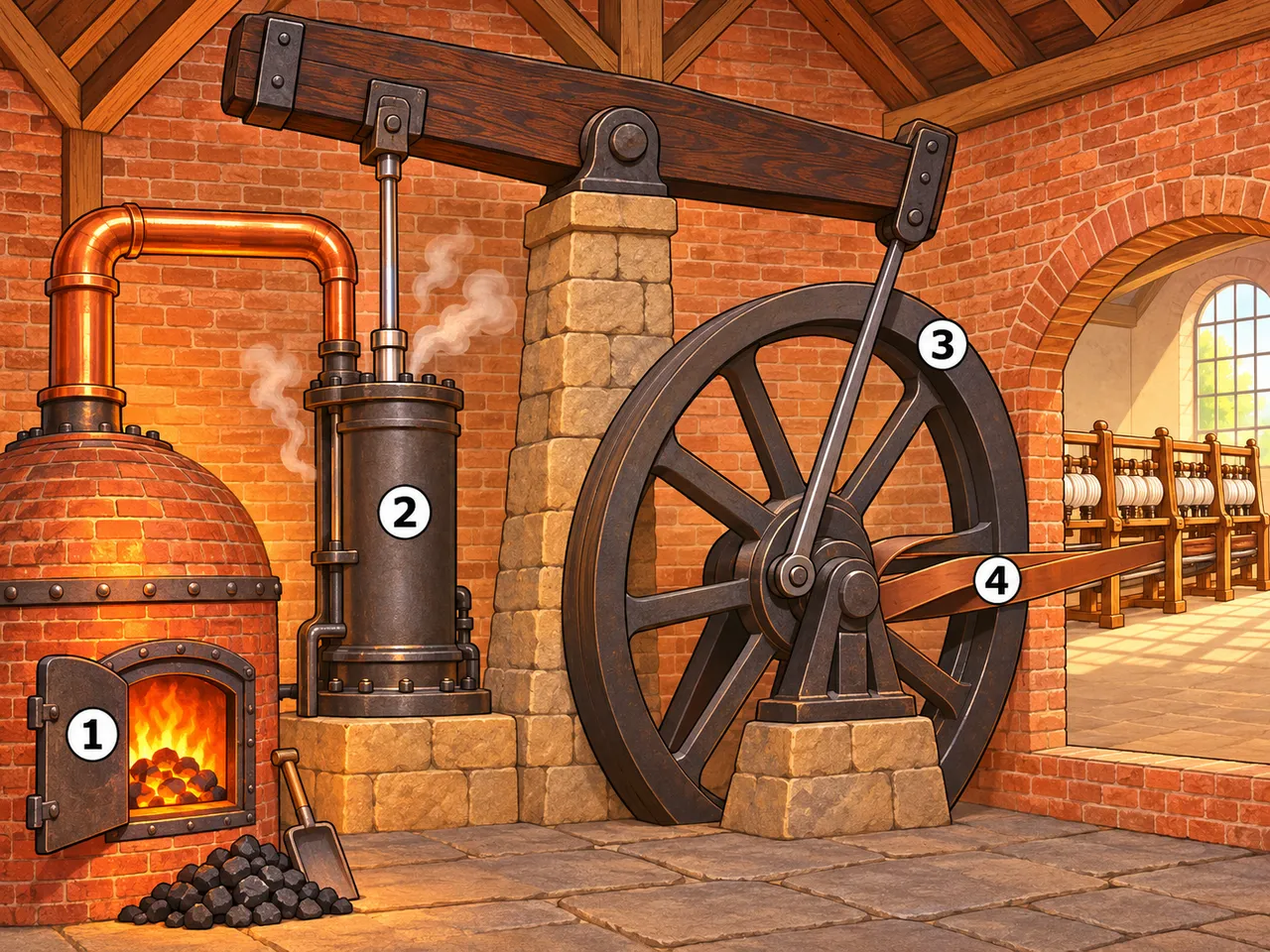
In the 1800s, factories began to burn coal to boil water and make steam, which pushed the big parts of an engine. That engine could turn every machine in a factory, so mills no longer needed a river’s water wheel or teams of horses.
In the picture
- Coal fire under the boiler: burning coal heats water until it turns into steam
- Cylinder and piston: the pushing steam moves the piston up and down
- Flywheel: the rocking beam turns this heavy wheel round and round
- Leather belts: they carry the turning power to the spinning machines
Examples
- A steam train at a heritage railway still burns coal to make steam that turns its wheels.
- When water boils in a pan with a lid, the steam pushes the lid up and makes it rattle.
Key takeaways
- Steam engines burned coal, so factories could be built anywhere, not only next to a river.
- One steam engine could power a whole room full of machines at once.
Quiz: The Steam Engine Powers the Factory (Age 10)
-
Why could factories with steam engines be built far away from a river?
-
What job did the burning coal do in a steam engine?
-
How many machines could one steam engine power?
The answers, each with its explanation, are in the app. This quiz is free there while the lesson is in the free week.
Get the app
Free app, optional subscription
App Store Google Play
Carry on in the app
At least one new illustrated lesson every weekday for your child’s year, with its quiz and a reminder at 6:15 pm.
Your child’s teacher does not use My Enhanced Teacher yet?
Tell them about it