Mon Prof Augmenté
The Global Carbon Cycle
Age 18 · Science
Open to everyone until Sunday, November 29
To keep it, print it while it is open.
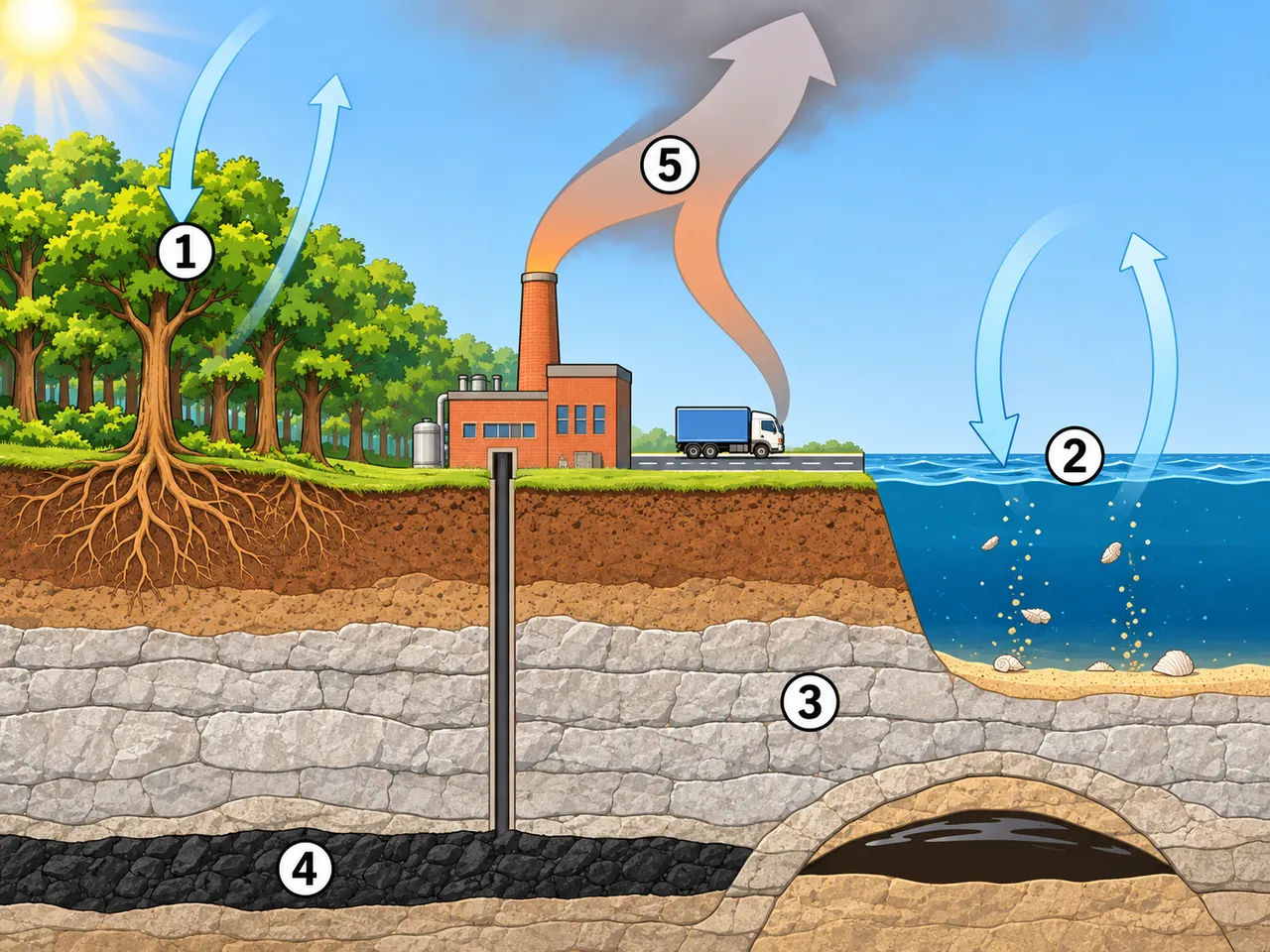
Carbon moves constantly between the atmosphere, the ocean, living things and rocks, in exchanges that stayed roughly balanced for thousands of years. Burning fossil fuels returns carbon that was locked underground for millions of years to the air far faster than natural sinks can absorb it, so atmospheric CO2 rises.
In the picture
- Forest: photosynthesis takes CO2 from the air, while respiration and decay return it
- Sea surface: the ocean dissolves CO2 and releases it, absorbing slightly more than it gives back
- Limestone layers: shells and sediments lock carbon into rock for millions of years
- Coal and oil: ancient organic carbon buried deep underground
- Chimney and exhaust stream: combustion sends fossil carbon into the atmosphere as extra CO2
Examples
- Driving a petrol car releases carbon that plants captured hundreds of millions of years ago.
- A fizzy drink going flat shows CO2 leaving a liquid, just as a warming ocean holds less dissolved gas.
Key takeaways
- Atmospheric CO2 has risen from about 280 ppm before the industrial era to more than 420 ppm today.
- Oceans and land absorb roughly half of human emissions; the rest accumulates in the atmosphere.
Carry on in the app
At least one new illustrated lesson every weekday for your child’s year, with its quiz and a reminder at 6:15 pm.
Get the app
Free app, optional subscription
App Store Google Play
Your child’s teacher does not use My Enhanced Teacher yet?
Tell them about it