Mon Prof Augmenté
How an Alternator Makes Electricity
Age 14 · Science
Open to everyone until Monday, November 16
To keep it, print it while it is open.
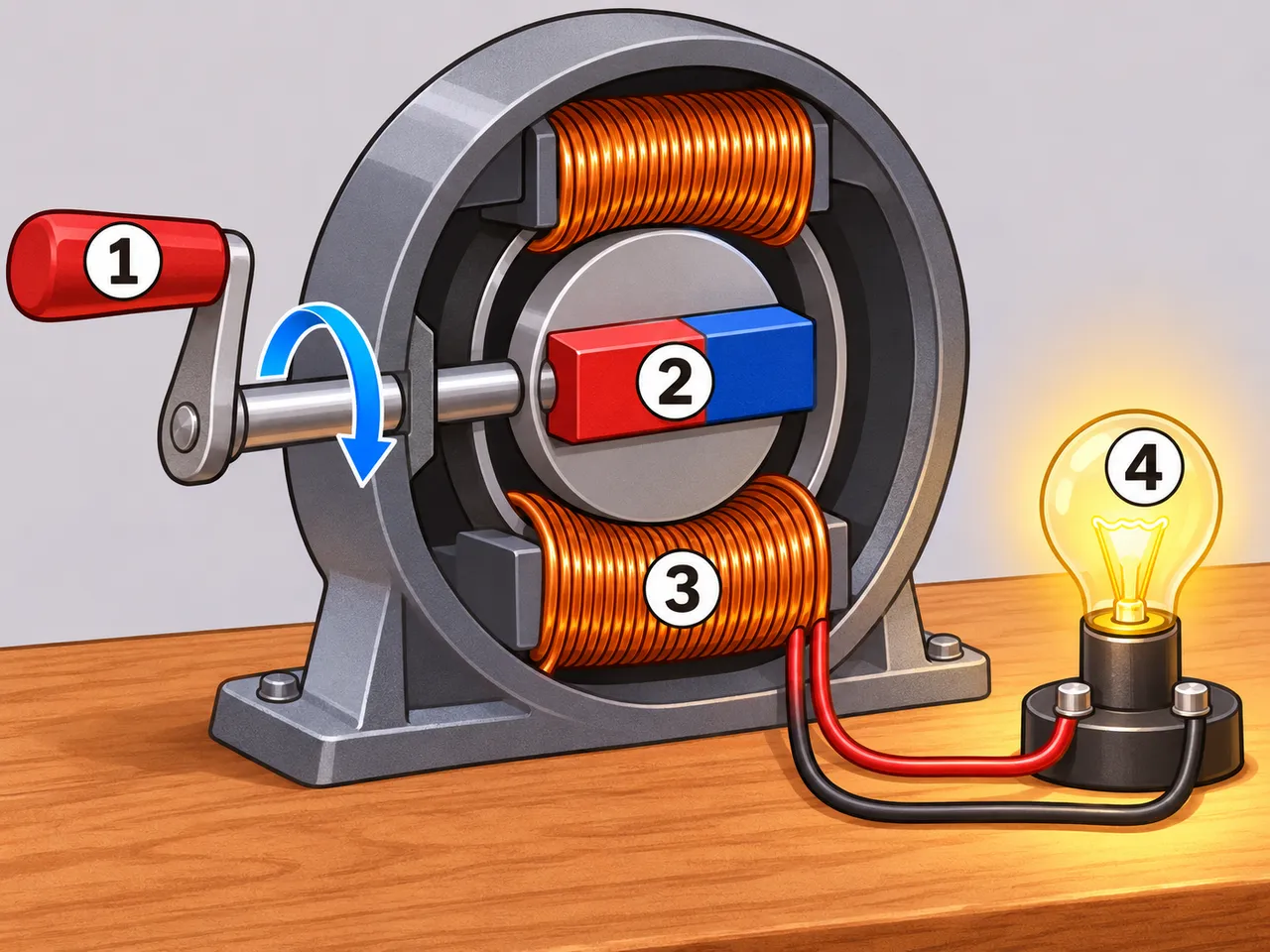
When you turn the shaft, a magnet spins next to fixed copper coils, and its moving magnetic field pushes electric current through the wire. The current keeps changing direction as the magnet turns, so it is called alternating current.
In the picture
- Hand crank: your muscles supply mechanical energy that turns the shaft
- Spinning magnet: its magnetic field sweeps past the coils as it rotates
- Fixed copper coils: the changing magnetic field induces an alternating current in them
- Lamp: electrical energy turns into light and heat
Examples
- A bicycle dynamo that powers the bike lamp while you pedal
- A wind turbine whose blades turn a large alternator
Key takeaways
- An alternator converts mechanical energy into electrical energy
- A magnet moving near a coil induces a current; faster turning gives more current
Quiz: How an Alternator Makes Electricity (Age 14)
-
What kind of energy change does an alternator carry out?
-
Why is the current made by an alternator called alternating current?
-
What happens if you turn the alternator’s shaft faster?
The answers, each with its explanation, are in the app. This quiz is free there while the lesson is in the free week.
Get the app
Free app, optional subscription
App Store Google Play
Carry on in the app
At least one new illustrated lesson every weekday for your child’s year, with its quiz and a reminder at 6:15 pm.
Your child’s teacher does not use My Enhanced Teacher yet?
Tell them about it