Mon Prof Augmenté
Same mass before and after
Age 13 · Chemistry
Open to everyone until Monday, November 23
To keep it, print it while it is open.
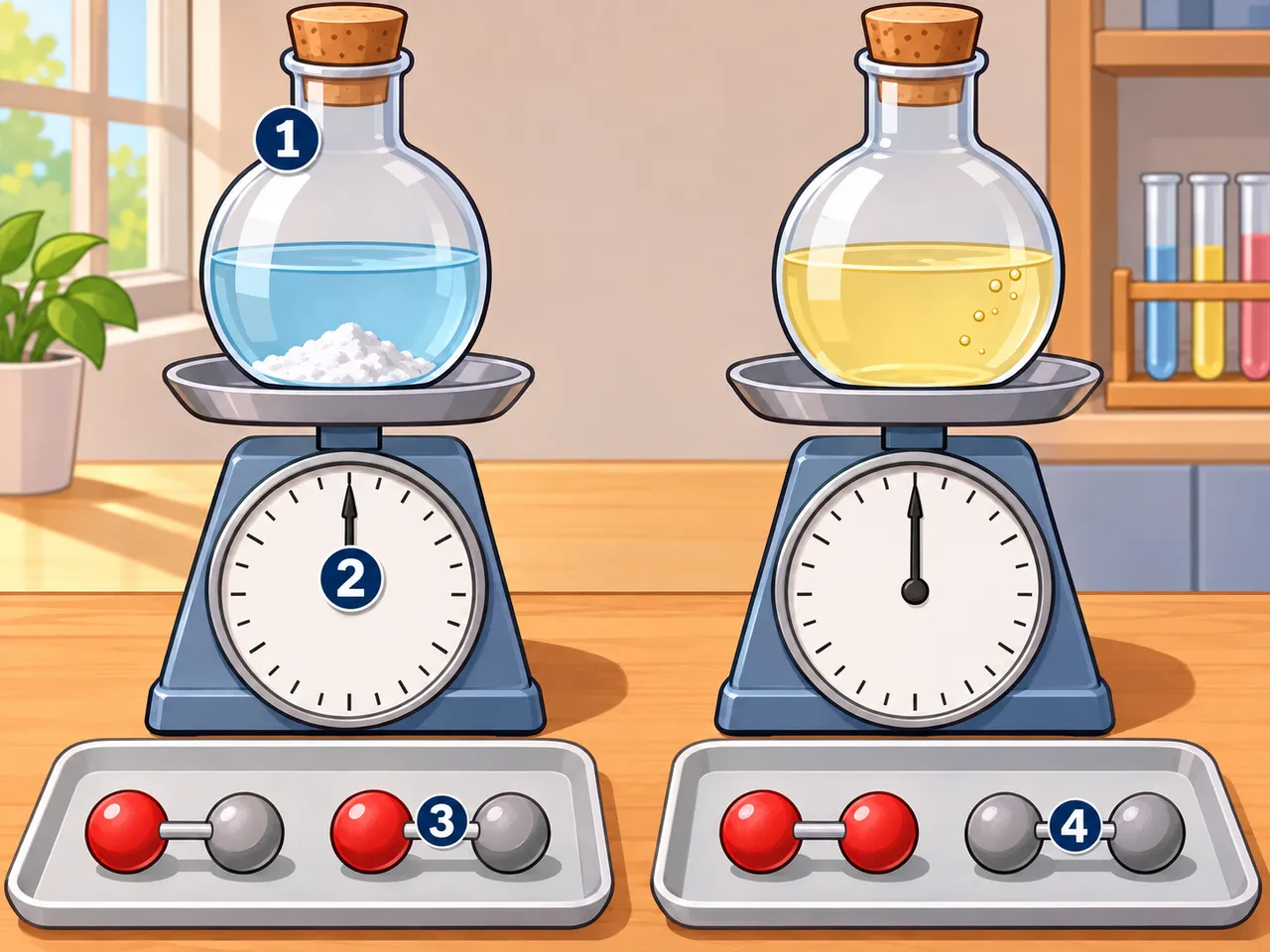
In a chemical reaction, atoms are not created or destroyed. They just join up in new ways to make new molecules, so the total mass stays the same.
In the picture
- Sealed flask before the reaction: nothing can enter or escape
- Balance pointer: the mass reads the same as after the reaction
- Starting molecules: red and grey atoms joined in pairs
- New molecules: the same four atoms regrouped in different pairs
Examples
- A sealed bottle of fizzy tablets in water weighs the same before and after the tablets fizz.
- A candle burning inside a closed jar keeps the jar’s total mass unchanged.
Key takeaways
- Atoms are rearranged in a reaction, never lost or made.
- Mass of reactants equals mass of products in a closed system.
Quiz: Same mass before and after (Age 13)
-
What happens to the atoms during a chemical reaction?
-
A reaction happens in a sealed flask on a balance. How does the mass after the reaction compare with the mass before?
-
Why must the flask be sealed for the mass on the balance to stay the same?
The answers, each with its explanation, are in the app. This quiz is free there while the lesson is in the free week.
Get the app
Free app, optional subscription
App Store Google Play
Carry on in the app
At least one new illustrated lesson every weekday for your child’s year, with its quiz and a reminder at 6:15 pm.
Your child’s teacher does not use My Enhanced Teacher yet?
Tell them about it