Mon Prof Augmenté
Particles and a Nucleus
Open to everyone until Saturday, October 3
To keep it, print it while it is open.
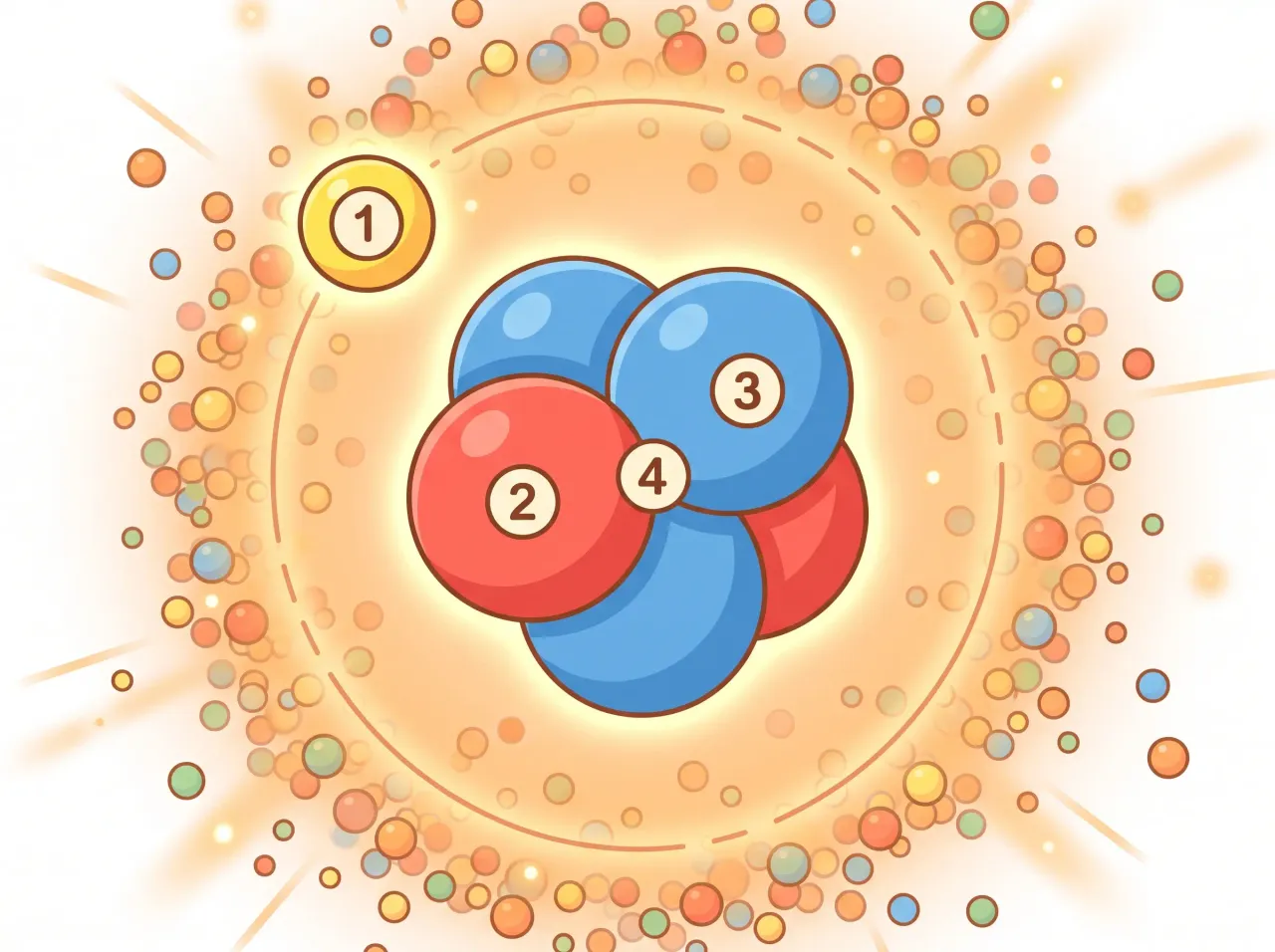
A hot, crowded cloud contains tiny particles. Protons and neutrons can join into a small central core while electrons move separately.
In the picture
- A lone electron: a tiny negative particle moving by itself.
- A proton: a heavier positive particle.
- A neutron: a heavier particle with no electric charge.
- A compact nucleus: protons and neutrons joined in a tight core.
Examples
- Droplets on a cold window can merge into one larger drop.
- A magnet can pull loose paper clips into a tight cluster while other clips stay apart.
Key takeaways
- Protons and neutrons can join to form atomic nuclei.
- Electrons are much lighter and can stay separate from nuclei.
Carry on in the app
Three questions on this lesson, to check the idea stuck. Free in the app while the lesson is in the free week.
At least one new illustrated lesson every weekday for your child’s year, with its quiz and a reminder at 6:15 pm.
Get the app
Free app, optional subscription
App Store Google Play