Mon Prof Augmenté
Groups inside groups and a family tree of life
Age 11 · Biology
Open to everyone until Thursday, November 12
To keep it, print it while it is open.
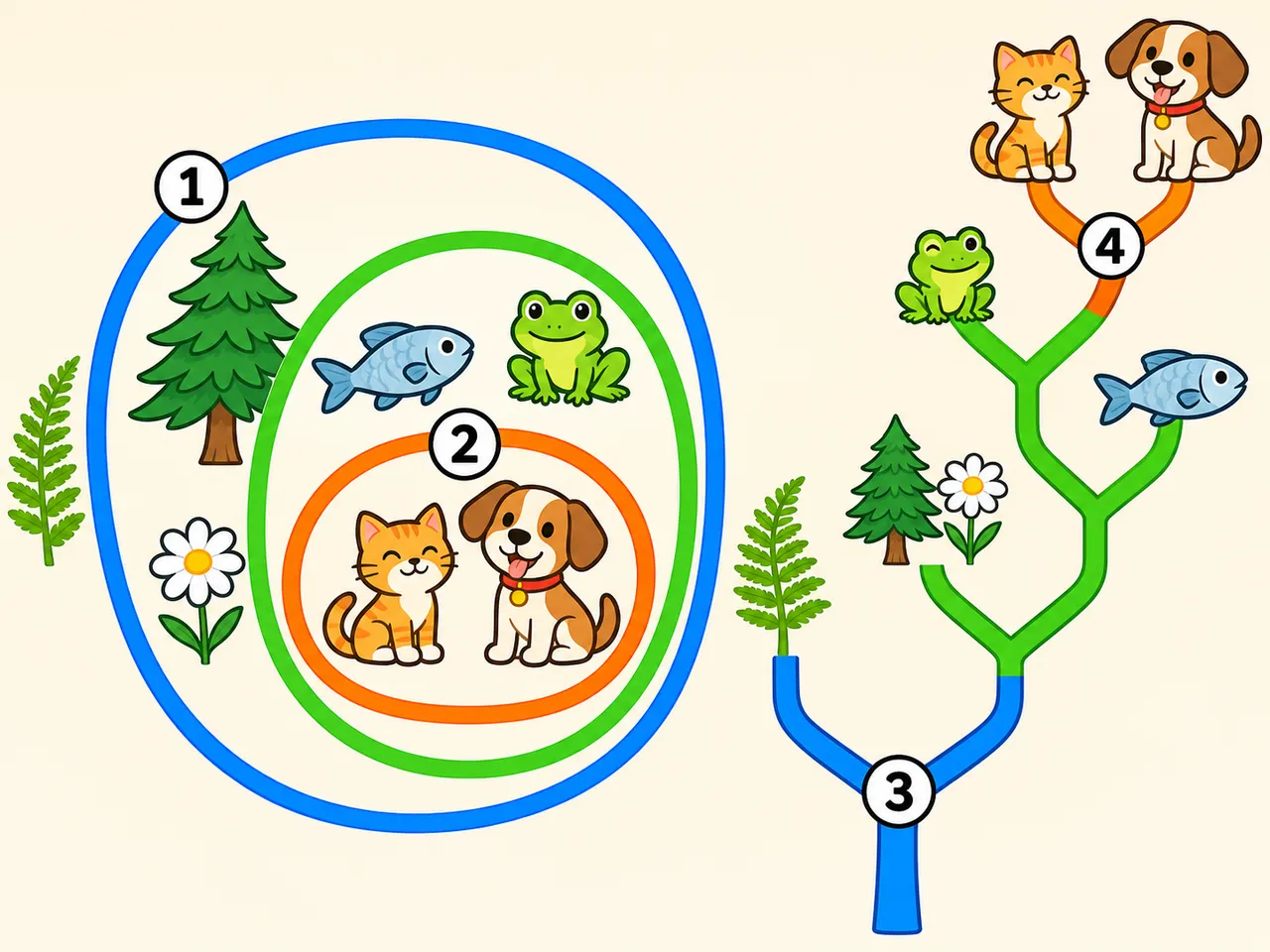
Living things can be sorted into big groups that hold smaller groups, using features they share. The same sorting can be drawn as a tree, where each fork is an ancestor shared by everything that grows from it.
In the picture
- The biggest group: living things sharing a few basic features, with many kinds inside
- The smallest group: very close relatives that share the most features, like cat and dog
- A fork low on the tree: a distant ancestor shared by all the branches above it
- A fork high on the tree: a recent ancestor shared by two close relatives
Examples
- A cat and a dog both have fur and feed milk to their young, so they sit in the same small group.
- A fish and a frog both have backbones, but a cat shares more features with a dog than with either of them.
Key takeaways
- The more features living things share, the smaller and closer their group is.
- A fork in the tree is a shared ancestor: the closer the fork, the closer the relatives.
Quiz: Groups inside groups and a family tree of life (Age 11)
-
The more features living things share, what is their group like?
-
On the tree of life, two animals split from a fork very near their branches. What does this tell you?
-
What does a fork low on the tree stand for?
The answers, each with its explanation, are in the app. This quiz is free there while the lesson is in the free week.
Get the app
Free app, optional subscription
App Store Google Play
Carry on in the app
At least one new illustrated lesson every weekday for your child’s year, with its quiz and a reminder at 6:15 pm.
Your child’s teacher does not use My Enhanced Teacher yet?
Tell them about it